Some days, the practices provided comfort, others it was an escape. Most days, the spiral pulled her back to the same wound, same lesson, different altitude.
And then there was her boss.
He said “sweetheart” like it was harmless. He told jokes that landed just a little too close to her body. He praised her work in meetings and punished her afterward with proximity; leaning in too far, comments that weren’t quite explicit enough to quote, but clear enough to sting. Sofia told herself it was nothing. She told herself she needed the job. Her brother was in community college. Her grandmother’s rent had gone up again. Sofia had learned how fast stability can vanish.
So she stayed. She performed. She smiled. Yes…Yes…Yes!
 The Noticing
It happened on a Thursday, the office emptied that evening and the air turned thin with fluorescent fatigue. Sofia was finishing a report, because she always finished the report, and when her boss appeared beside her desk, it was like a shadow that thought it owned the light.
“Working late again,” he said. “That’s why you’re my favorite.”
Her stomach tightened. Her body always knew first. “I’m about to head out,” Sofia said, keeping her voice polite, professional, small.
“Stay,” he said, too smoothly. “We should talk about your future. In my office.” He gestured down the hall. His door was half open. The hallway was empty. Adding, like an afterthought, like it was nothing. “Door closed. Privacy.”
Something inside Sofia went very still.
Not calm. Not peace. Frozen. The old system booted up. The ancient bargain returned.
The Conditioned Reaction
In Sofia’s body, the past ran the present. Her breath went shallow. Her ears rang. Her mind tried to leave, because leaving had once been the only way to survive. “Okay,” she heard herself say, like her mouth belonged to someone else. In his office, he talked about “loyalty” and “being flexible” and how “competitive things are.” His eyes tracked her face like he was assessing how much she would tolerate. Sofia’s inner world collapsed into one frantic instruction: Don’t make him mad. Don’t lose your job. Don’t be difficult.
 Shame rose like a tide. Not because she didn’t know it was wrong, but because her body had learned long ago that wrong things happen when you try to resist. If she complied, she could get out intact. If she fought, she might lose everything. And afterward, however it ended, however she escaped, she went home and sat under the shower until the water ran cold. The rage showed up later. Not as fire, but as acid, turned inward. Why didn’t you stop it? Why are you still like this? Why can’t you just say no?
At work the next day, she smiled and performed and disappeared. Her body paid the bill: migraines, insomnia, jaw pain, an exhaustion so deep it felt like grief. Her yes, kept her employed, but it cost her herself.
Remembering to Remember
Healing didn’t arrive as a revelation. It arrived as a practice. Weeks later, after another comment, another brush of proximity, Sofia locked herself in a bathroom stall and pressed her palm to her chest like she was trying to keep her heart from sprinting out of her body. She breathed low…into her belly, into her hips, into her legs. She felt her feet. She named what was true. This is not small. This is not nothing. This is happening. And I do not have to disappear. She heard her therapist: Anger is not your enemy. Anger is the part of you that knows you matter. She heard her kung fu teacher: The ground is real. You are real. That night, she opened her journal and wrote one sentence in thick, dark ink: My NO is holy. Not because it was polite. Not because it was easy.
Because it was hers. And a holy thing, she realized, does not need permission to exist.
The Chosen Response
Another Thursday, same fluorescent hum, same hallway draining into emptiness. Same boss appearing beside her desk like he’d rehearsed it.
 “Stay late,” he said. “Let’s talk about your future. My office. Door closed.”
Sofia felt the reflex rise, the old urge to go numb, to comply, to shrink.
But she didn’t leave. She stayed inside her body.
Her feet pressed into the floor like roots. Her spine lengthened. She let the anger come…not as chaos, but as heat with direction. Protective. Clean.
She looked at him and said, “No.” One word. No smile. No apology.
His brows lifted, annoyed. “Excuse me?”
“I said no,” Sofia repeated. Her voice was steady, but there was fire in it now, the kind that had been waiting a long time. “And I want to be crystal clear: your request is inappropriate.”
He gave a tight laugh like she was the problem. “Don’t be dramatic. It’s just a conversation.”
Sofia stood. Calm. Burning.
“Here’s what’s going to happen,” she said. “You’re going to stop asking me to meet alone after hours. You’re going to stop the comments. You’re going to stop the hovering and the ‘sweetheart’ and the little tests to see what you can get away with.”
He leaned in, because men like him always lean in when they’re challenged. “You know,” he said, voice low, “people who aren’t flexible don’t always last here.”
Sofia felt fear flash, hot and quick. Bills. Her brother. Her grandmother. The old survival math. And then something deeper rose up underneath it: rage that had been trained to go quiet for decades. She stepped closer, not into his space, but into her own power.
 “Let me tell you something,” she said, her eyes locked on his. “I was trained my whole life to be ‘flexible’ for men who thought they had a right to me. I’m not that girl anymore.”
He froze for a fraction of a second. Just a flicker.
Sofia turned her laptop slightly so the camera was visible, its small dark eye staring back.
“Also,” she said, voice sharp as a blade, “this entire conversation has been recorded on my webcam.”
The air changed. That first moment, spring might be real, a breath of fresh air.
His face drained. His mouth opened, closed. Terror flashed across his features, pure, animal recognition that the story he controlled was no longer private.
“What…” he started.
“You heard me,” Sofia said. And now the anger had a voice, big, clean, unapologetic. “You don’t get to do this in the dark. You don’t get to isolate me. You don’t get to threaten my livelihood because you feel entitled to my body or my silence.”
She leaned in just enough for him to feel the boundary, the line in the sand.
“And if you ever,” she said, each word deliberate, “try this shit again, if you ever invite me into that office and ask me to close the door like I owe you privacy for your harassment, I will report you so fast it will make your head spin. Do you understand?”
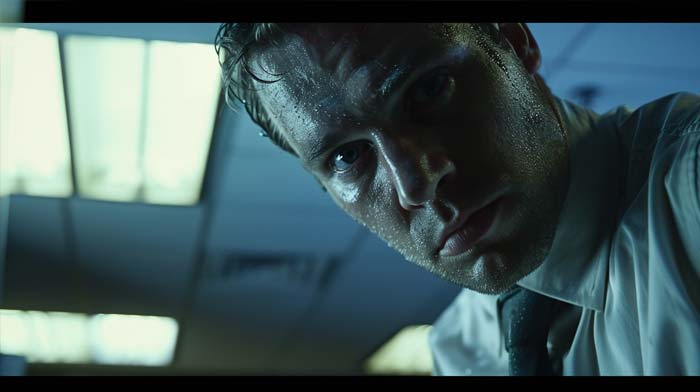 He stared at her like he’d never seen her before. Good. Because she hadn’t, either.
He tried to recover, tried to put on the manager mask, the authority voice. But it cracked at the edges.
“You’re making a mistake,” he muttered.
Sofia’s laugh was short and hard, not sweet.
“No,” she said. “I’m making a fucking choice.”
She shut her laptop. Picked up her bag. Walked past him with the calm of someone who had finally stopped negotiating with her own dignity. Out in the parking lot, her hands shook. Her knees trembled. Her nervous system screamed.
But she didn’t collapse. She breathed. She pressed her palm to her chest again and whispered, “I’m here. I’m here. I’m here.” She texted an older woman at work: I need you tomorrow. I’m reporting. She called her brother: “Hey, listen. I did something hard today.” And when her grandmother answered, Sofia didn’t explain everything. She just said, “Abuela… I’m learning how to protect myself.” Her grandmother was quiet for a moment, then said softly, “Finally, m’ija.”
A New Life
Weeks later, Sofia caught her reflection in a window and didn’t look away. Her eyes were still tired. Her life was still complicated. The world was still the world. But her posture had changed. She stood like someone who belonged to herself. She still spiraled.  She still had days when fear returned. Healing still asked her to practice, again and again, the pause from reaction, the skill of presence, the courage of truth, the freedom of response. And now, when the old story tried to take over, she had a new response:
No. And in that no, her authentic Yes was born, steady, luminous, unborrowed. Not yes to pleasing. Not yes to surviving. Yes to life. Yes to dignity. Yes to the future we inherit from what we heal.

 The Pattern