 Not as a thought experiment or a survival craft; as a new reality. Because “economy” means the management of our shared home, then an economy that makes our home less livable is not an economy; it’s a malfunctioning machine, full of malfunctioning components.Machines that still produce impressive numbers while the people holding them grow exhausted, while the soil thins, while the air thickens, while communities fray, while meaning feels like a resource we can’t afford anymore. We have mistaken the financial system for the economy itself.We have treated money as if it were the heartbeat of life, rather than a technology we made to express the management of life.
In the Bardo, those confusions become costly.
The Bridge Is Not the Destination
It’s tempting, in times like these, to want the “imagined future” fully drawn; polished plans, sweeping reforms, elegant theories that promise to end the ache. But the Bardo doesn’t reward fantasies. It rewards waiting, sensing and practicing. The bridge is the work: pier after pier, girder after girder, plank after plank, learning how to move without pretending we can see the whole shoreline in advance.
This is why Thinking in Systems matters here; not through an academic lens, but as grounded practice. It reminds us that what we call “problems” are often patterns produced by structures: by stocks and flows, by feedback loops, by delays and unseen traps, by goals that quietly steer everything. When these structures are dominated by reinforcing loops; loops that amplify themselves; systems become unstable, even when every participant believes they’re acting rationally.
Reinforcing loops are powerful because they create momentum. They reward what they reward. They make yesterday’s advantage tomorrow’s inevitability. “Success to the successful” or “from good to great,” never asking what’s enough? Their signatures: capital attracts capital, attention captures attention, bias reinforces bias, and resources concentrate where resources already exist. Once a reinforcing loop gains speed, it becomes a current you have to swim against for change.
 Balancing loops are the answer. They are the system’s immune system responding to the signal: too much or too little. They restore stability by applying limits, replenishment, repair, sufficiency, they are the course correction. Without balancing loops, a system doesn’t just “grow”, it overshoots. And when it overshoots, there is no place of stability. It snaps like a runaway train, flying off the tracks!
The hard truth is this: our current economy has built many high-powered reinforcing loops, while at the same time weakening the balancing loops so they are no longer strong enough to protect the home. Being in the Bardo feels like a runaway train because it is. And then comes the deeper question: if an economy is the management of home, what does a living home do?
It listens…It senses…It self-corrects.
Open The Front Door and Listen
A living economy begins with a different wager: life knows something about staying alive.
Open the front door and listen. Beneath the hustle and bustle of commerce, there is another register: the quiet industry of living things keeping themselves alive. Leaves angle themselves toward light. Soil exhales through mycelial threads. A bee, feeling the air cool, warms her sisters by shivering her wings. None of it is random. Life is continuously sensing, adjusting, improvising to remain alive.
 This is the part we forget when we treat society like a machine. Machines do not feel pain. Machines do not notice harm until something breaks. Machines do not care whether the home is livable; they care whether the output meets the target.
Living systems are different. They run on feedback. They don’t ask for perfect predictions; they ask for good sensing and timely correction. Living System Design takes that living part seriously. Treating societies like ecosystems that must sense, respond, and regenerate. Valuing Community, Sovereignty, Intention, Evolution, Compassion, Stewardship, Contribution. Not as decorative ideals, they are the set points of a healthy system: the signals we measure to know whether the home is becoming more livable or less.
And here is the crucial distinction: in living systems, values are not static. They are homeostatic; held in dynamic equilibrium. Nature uses feedback to remain stable. When the system is stable, signals affirm coherence. When the system is out of balance, signals change; showing where correction is needed.
This is where principles kick in, not as moral rules, but as guardrails; Regeneration, Sufficiency, Emergence, Purpose, Consciousness, Tangible Output, Interconnectedness; define the landscape in which correction happens. They’re how we keep a system from “solving” one problem while unknowingly creating three others. They are how we avoid optimizing ourselves into fragility.
In a living economy, values tell us how we’re doing. Principles tell us how to correct. The economy becomes less like a scoreboard and more like a body’s vital signs.
 Neighborhoods Have Vital Signs Too
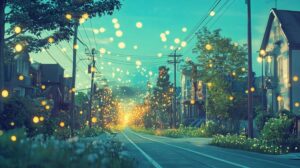
Imagine a neighborhood as an organism. It has pulse, temperature, oxygen saturation and respiration rate. Not metaphorically, practically. Food access. Housing stability. Clean air. Dependable warmth. Social trust. Learning pathways. These are its vital signs. In a living economy, we sense them where they happen, not months later in a distant spreadsheet. We must shorten feedback loops.
If food insecurity spikes, the response is not a report. It’s a weekly buying club, or a shared kitchen that turns surplus into meals. If heat waves intensify, the response is not a study alone; it’s shade corridors, cool rooms, neighbor check-ins that keep elders safe. When a wage earner gets sick, a care circle arrives with soup, rides, and rent support; so a short-term shock doesn’t cascade into a devastating eviction.
These are not side projects. This is homeostasis at civic scale.
This is where Contributionism enters; not as an ideology to argue about, but the implementation of a new economic framework. Contributionism translates these values and principles into daily economics. It shifts the system’s center of gravity from extraction to nourishment: from maximizing returns on capital to meeting human needs and staying within planetary boundaries, return on impact..
In Contributionism, the scoreboard changes. We still count; but we count differently. Needs met with dignity. Capacities developed. Commons strengthened. Waste turned into input. Harm repaired quickly. People included. Contribution made visible and honored because contribution stabilizes the whole. And the pathway is built like a venn diagram, overlapping circles, because living systems don’t operate in isolation; they interconnect.
MEconomy stabilizes essentials; food, shelter, care, learning, safety; so people aren’t living on a cliffs edge, one step away from catastrophe.
WEconomy grows commons; microgrids, tool libraries, ride cooperatives, makerspaces, data trusts; lowering the cost-per-need-met and creating redundancy.
FREEconomy enables the surplus of imagination; art, invention, research, play; so adaptation remains possible without cannibalizing the base.
And at the center where these circles overlap, you!
 When the base is steady and commons are strong, creativity stops being an elite escape and becomes everyone’s work of renewal. This is how you build a bridge in the Bardo: you stabilize the ground before taking the next step.
Reinforcing Loops Make Us Fast. Balancing Loops Keep Us Alive.
If our current system is dominated by reinforcing loops, the work of a living economy is to install balancing loops; strong enough to interrupt runaway dynamics without crushing life. Balancing loops are sufficiency in action.
It is the corridor of conditions where life flourishes. In a garden, too little water and the plants wither; too much and they rot. Translated into civic practice, sufficiency caps extractive appetites, designs things to be repaired, favors reliability over novelty in essentials, routes surplus back into shared capacity. It frees us from the treadmill where security always lives just beyond the next purchase or the next quarter. Sufficiency changes what we celebrate, because an economy is not only flows and things, it’s stories.
What we praise becomes an attractor: the hidden pattern that pulls behavior into its shape. Profit-first stories produce cultures of “make the number,” attention capture, plan obsolescence; they reward enclosure and call it innovation. Living-economy stories do something else. They lift up the neighbor who convened childcare swaps. The crew who turned a vacant lot into a garden that drains stormwater and feeds families. The nurse who organized a weekend clinic with volunteer translators. The youth who mapped shade deserts and got trees planted where elders wait for buses. In each story, status accrues not for attention, but to contribution; because contribution keeps the whole alive.
 If that feels “soft,” look closer, these practices harden systems against shock. Redundancy in food pathways blunts supply disruptions. Local energy loops ride out outages. Dense social networks reduce loneliness and vulnerability alike. Shared tools mean fewer single points of failure. Repair cultures reduce waste and skill loss. And every time surplus is routed back into commons rather than siphoned away, the next effort begins on stronger ground. Balancing loops are not anti-progress, they sustain life.
Senses as Data: Beyond the Dashboard
A living economy requires a change in what we consider “real” information. Quarterly reports are not useless, they are late, they are abstract. Often arriving after harm has already shown up as consequences. The Bardo demands earlier signals, nearer signals, more human signals.
Senses offer that. The smell of smoke in late summer. The sight of an empty fridge. The sound of a neighbor’s car not starting and a job that is two bus transfers away. The way a child’s shoulders tighten when school lunch becomes a math problem. The heat radiating off asphalt at midnight. The quiet of elders waiting at a bus stop with no shade. The subtle shrinkage of community life when everyone is working too many hours to even catch their breath, too tired to contribute.
What if we treated lived experience as a primary data stream for the economy; the way a body treats pain as information? Not as drama, as a signal. And what if we paired that sensory truth with systems thinking; the signal isn’t about blame, it’s a diagnosis, providing feedback! This is how you restore balancing loops: you shorten the distance between harm and response. You bring decision-making closer to where impacts land. You make corrections possible without waiting for distant permission.
Not everything can be local. Some standards must be shared. But the bias flips: we trust ground truth, build structures that let sensing travel quickly and corrections take effect without delay. We practice transparency about constraints. We keep learning visible. We measure what signals health; not only throughput, but recovery time, redundancy, participation density, ecological indicators. The warm-data questions that tell you whether the relational soil is alive:
Do people feel seen? Are conflicts repaired faster? Is trust rising?
A living economy does not confuse silence with stability. It listens…It senses.
 How to Walk the Bridge
The Bardo is hard because it tempts us to extremes. Either we freeze; clinging to what we know because it is familiar. Or we sprint; chasing grandiose ideas of instant transformation because uncertainty is uncomfortable. But the art of the Bardo is not freezing or sprinting. It’s walking.
Walking means grief without collapse. It means humility without paralysis. It means acting without pretending we can control everything. It also means starting right where we are, putting one foot in front of the other.
Choose a vital sign you can touch: school lunches, neighborhood warmth, safe transit at night, language access at clinics, weekend learning for kids. Name the purpose simply: we are doing this to make life more livable here. Seek who might already be trying. Add one stabilizing layer: a schedule, a kit, a small fund, a shared doc, a rota. Make contributions visible. When something works, teach it forward; openly, without a paywall; because regeneration compounds when patterns spread.
This is where Living System Design’s “fractal integrity” matters: the pattern that works in one block should be small enough to replicate and flexible enough to adapt. Simple rules beat perfect plans:
- Meet needs first
- Route surplus to the commons
- Run safe-to-try experiments
- Repair harm fast
- Tell the truth about results
Repeat those rules across scales; household, block, neighborhood, bioregion; and you will recognize the shape that emerges: less drama at the base of life, more room for culture and invention above it.
There will be setbacks. A pilot will stall. A leader will burn out. A storm will undo a season’s work. The machine mind calls that failure and reaches for control. The living mind calls it information and adjusts: rebalances roles, widens the circle, slows where rushing harms, speeds up where delay causes damage, composts what’s not working, and always keeps the purpose front and center…continued life. A living economy is not a single decree. It is a thousand small acts of coherence that change what is normal.
In the Bardo, that is how bridges become real: piece by piece, with hands that learn what the body already knows; home is not managed by numbers alone. Home is managed by attention, by relationship, by feedback, by repair, by the steady willingness to keep coming back to what keeps life alive.
 The Art of Walking
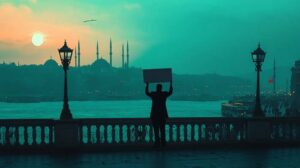
On the Galata Bridge, the water only stops moving momentarily, that moment when the tide switches from coming in to going out or vice versa. The city the same breathing; in…out…in…out. The currents don’t ask if we are ready. They simply continue; ancient, indifferent, generous. Through it all, the bridge holds, not because it can predict the sea, but because it was built to live with it.
This is the invitation.
We do not have to wait to begin. We do not have to pretend we can see the far shore. We only have to become faithful, take the step in front of us: listen with the body, notice the loops we reinforce and the ones we neglect, install the balancing loops that stabilize the system.
Tomorrow, step outside and listen again. You are standing in the living classroom. Everything around you is practicing the art we most need now: the continuous, collaborative work of staying alive.
Build an economy worthy of that instruction; an economy that senses, self-corrects, and regenerates. An economy that meets needs with dignity, strengthens commons, protects imagination, repairs harm, and celebrates the hands that hold the home together.
We are in the Bardo. The bridge is real.
All that remains is to walk; one neighborhood, one relationship, one shared table, one commons at a time.


 Not just a bridge of geography, but a bridge of civic time. A bridge between an old world ending and some unknown otherness on the other side. The in-between has a name in certain traditions: the Bardo; the space between death and rebirth, the corridor where what was can no longer hold, and what will be has not yet arrived. The Bardo is not a slogan; it’s a weather system; it has its own gravity; its own disorientation; Its own temptations: to cling, to rush, to pretend we’re not here.