Listening to Hear
Our current financial system is a machine where the gatekeepers are those who have accumulated the wealth that keeps the machine running and the machine is failing! There is a different option if we're listening.




















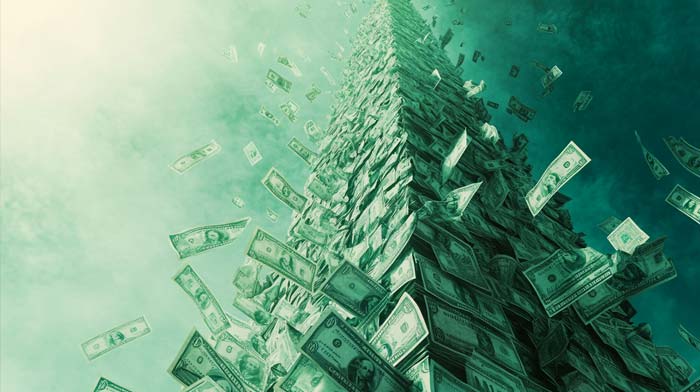
At that point, the financial system becomes both the scoreboard and the rulebook. Asset prices and market indices are treated as the definitive measure of whether “the economy” is healthy. Policy is written to keep those lines trending up: lower taxes on capital, weaker labor protections, deregulated finance, privatization of public goods. Piketty’s deeper point, especially in Capital and Ideology, is that this arrangement is not a natural law. It is justified and stabilized by stories—ideologies—about what is fair, efficient, or inevitable. Yesterday’s nobility invoked bloodlines and divine order; today’s elites invoke meritocracy and market discipline. In both cases, the underlying message is the same: protecting accumulated capital is synonymous with protecting “the economy.”
Once that story sticks, human beings and ecosystems are quietly repositioned as inputs to, or collateral for, the financial machine. The purpose of the economy—managing the home so that life can flourish—shrinks until it fits inside the purpose of the financial system: maximizing returns for those who already hold claims on future income.
Walter Scheidel’s The Great Leveler shows what happens when this continues unchecked. Inequality, he argues through centuries of examples, is rarely smoothed out by gentle reform alone once it becomes extreme. Historically, the big reductions in inequality have come from what he calls the “four horsemen” of leveling:
These are not policy preferences; they’re catastrophes that rip through societies, sometimes flattening wealth distributions but at staggering human cost.

Overlay Scheidel’s history onto Piketty’s data and the stakes of our confusion come into focus. If we equate “the economy” with the comfort of capital, then any attempt to build fairer tax systems, stronger safety nets, or shared public assets looks like an attack on the thing we are supposed to protect. Inequality deepens, social trust thins, and every downturn risks turning into something sharper. Instead of choosing to rebalance the management of our shared home, we drift toward the kind of crises that rebalance it for us.
For ordinary people, this doesn’t show up as a theoretical problem. It shows up as chronic insecurity. It looks like wages that stagnate while rents, food, medical bills, and education costs soar. It looks like parents taking on crushing debt so their children can chase credentials that might keep them from sliding backward. It looks like people working full time jobs and still needing assistance to afford food. It looks like being told, after a layoff engineered to “boost shareholder value,” that it’s nothing personal—just what “the economy” demands. The language of financial necessity masks the emotional and material violence being done to real lives.
If our home were only social, the damage would already be immense. But as Peter Frankopan reminds us in The Earth Transformed, our true home is biophysical: a restless planet whose climates, waters, soils, and living systems have shaped human history from the beginning. He traces how shifts in rainfall, temperature, disease vectors, and extreme events repeatedly redirected trade routes, toppled empires, and redrew the map of human possibility. Societies that paid attention to those signals sometimes adapted; others pressed on with extractive habits until the environment pushed back hard.
Today’s version of that story is climate breakdown, biodiversity loss, and widespread ecological degradation fueled by an economy that behaves as if the planet were a set of external warehouses and waste pits. When the financial system is treated as the economy, decisions about land, energy, and food are run through spreadsheets that discount the future and ignore most non-monetized harms. A forest becomes timber inventory or carbon credits; a wetland becomes “undeveloped” real estate; stable weather becomes a line of small print under “climate risk.”
Jane Jacobs, in The Nature of Economies, offers a different lens. She invites us to see economies not as machines but as ecosystems: webs of relationships that thrive on diversity, redundancy, and continuous, modest innovation. Healthy ecosystems recycle waste, generate niches for many forms of life, and balance competition with symbiosis. By contrast, a financialized system that chases scale, consolidation, and short-term extraction behaves more like a strip mine than a forest.
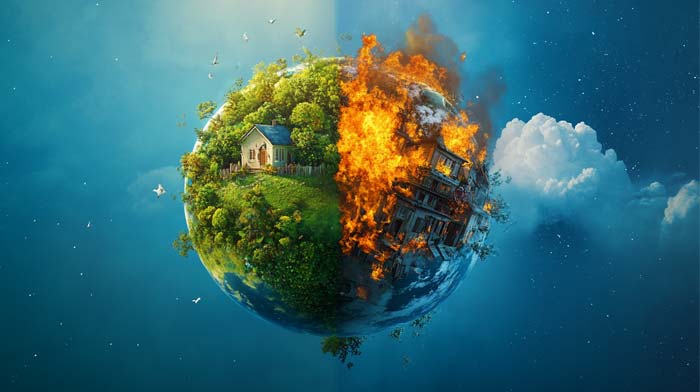
The consequences are no longer abstract. Crops fail under unprecedented heat and drought. Coastal communities face rising seas and intensifying storms. Air, water, and soil are contaminated in ways that lodge in bodies and bloodlines. These are not unfortunate side effects of a healthy economy. They are the symptoms of mistaking the activity of capital for the wellbeing of our shared home.
 Catastrophe as a feature, not a bug
Niall Ferguson’s Doom adds yet another layer by examining catastrophe itself—pandemics, financial crashes, wars, and other large-scale disruptions. Disasters, he argues, are rarely purely “natural” or purely “man-made.” They emerge from interactions between natural hazards and the vulnerabilities built into our social, political, and economic systems.
A system that worships financial indicators as the primary measure of economic health is, almost by design, bad at preparing for catastrophe. Investments in resilience—early-warning systems, robust public health, infrastructure built for a changing climate—are easy targets for budget cuts because their benefits are diffuse and long-term, while their costs are immediate and visible. By the time risks show up in market prices, it is often too late to avoid the worst outcomes.
Ferguson chronicles how institutions hesitate, deny, and delay when confronted with looming threats, especially if acting decisively would rattle markets or challenge entrenched interests. Under the spell of a capital-centric view of “the economy,” leaders are tempted to ask first, “What will this do to investor confidence?” instead of, “What does this do to people and the planet we depend on?” That inversion helps turn manageable problems into full-blown disasters. Further, when they do respond to disasters, it often entail large amounts of capital for the response, this is then reflected as growth in the economy.
All of this feeds into the third question: how does this confusion shape decisions by individuals, corporations, and governments?

For governments, policy becomes a matter of appeasing what Piketty would call the “proprietary classes” and what commentators loosely call “the markets.” Budgets are scored according to their impact on deficits and credit ratings more than their impact on human or ecological wellbeing. Stimulus to rescue banks labeled “too big to fail” is framed as unavoidable; sustained investment in housing, health, or decarbonization is framed as risky indulgence unless it can be justified in narrow growth terms. The original meaning of economy—the management of home—barely appears in the debate.
For corporations, purpose collapses into shareholder value. Even leaders who care about workers and the environment find themselves boxed in by compensation schemes tied to quarterly earnings and stock prices. A manager who chooses to protect a river at the expense of short-term profit risks being punished by investors or competitors. Under these conditions, “doing the right thing” becomes an exception that needs elaborate justification, rather than an assumed part of what it means to participate in the economy.
For individuals, the distortion seeps into identity and relationships. People are encouraged to see themselves as bundles of “human capital” competing in a market of selves. Education becomes an investment solely in future earnings, not in citizenship or meaning. Community becomes a network for professional advancement rather than mutual care. Even friendship and leisure are colonized by the language of productivity and optimization.
When the financial system masquerades as the economy, nearly every decision is reframed as a trade-off against some abstract notion of growth. Time spent caring for elders, raising children, restoring local ecosystems, or building community may be quietly devalued because it does not register in GDP or stock valuations. Yet these are precisely the activities that keep our shared home livable.
The authors we’ve been listening to do not pretend that disentangling the economy from the financial system will be simple. Piketty calls for deliberate, often contentious political choices to democratize access to capital and restrain its power. Scheidel’s bleak history warns what happens if we postpone such choices until crisis imposes them. Frankopan and Ferguson remind us that we are always operating within planetary and institutional systems capable of surprising us—sometimes gently, sometimes brutally—when we ignore their limits. Jacobs offers a quiet but radical invitation to redesign our economic life on the patterns of living systems rather than mechanical ones.
 Taken together, their work points toward a basic shift: from asking, “What does this do for capital?” to asking, “What does this do for our home?” That shift does not abolish finance; it puts it back in its rightful place as a tool among many, rather than the organizing principle of everything.
Reclaiming the original meaning of economy means judging our systems by different questions: Are people more secure, less anxious, more able to care and be cared for? Are our cities and landscapes becoming more resilient, more biodiverse, more capable of absorbing shocks? Are our institutions learning from past disasters and adjusting before the next ones hit, or are they locked into habits that privilege short-term gains?
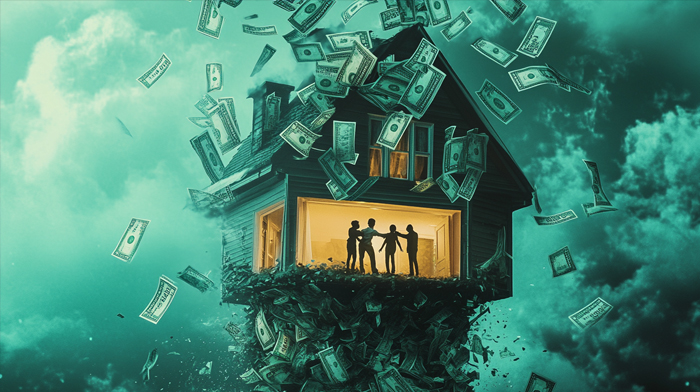
We already have the knowledge to begin that reorientation. The challenge is not technical; it is narrative and political. We must learn to say, with a straight face and a clear conscience, that an “economy” which thrives while its people and planet suffer is not actually thriving at all. It is, at best, a financial machine overheating in the corner of a house whose foundations are cracking.
To remember that economy means the management of home is to remember that our primary task is not to feed that machine, but to repair and tend the home itself: the people who inhabit it, the more-than-human life that makes it possible, and the fragile, beautiful systems that hold it all together. Only when we re-anchor our decisions in that understanding can we claim, honestly, to be doing what is “good for the economy.”
We call this new economy Contributionism.