Listening to Hear
Our current financial system is a machine where the gatekeepers are those who have accumulated the wealth that keeps the machine running and the machine is failing! There is a different option if we're listening.

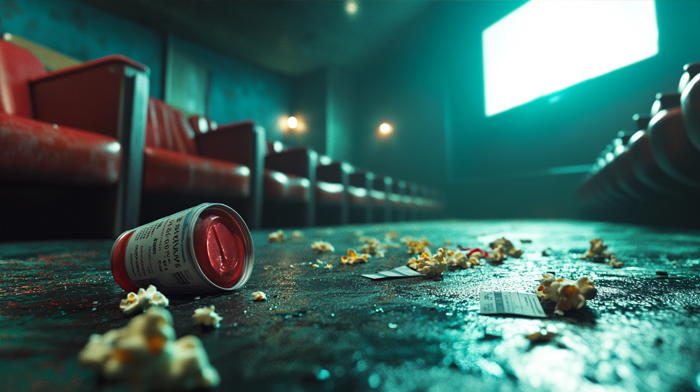
The theater emptied, the way it does when what was just seen touched an unexpected spot, slowly, quietly, almost a slow death march, eyes down. Popcorn bits visible in the aisle lights. The feel of sticky soda on the carpet as the crowd funneled out the narrow door. Outside, the bright screens flashed, bringing a distressed feeling to everyone’s nerves.
Graham and Luke left the building and stood under the awning, not walking yet, not ready to let the night end. They’d been friends long enough to know when something needed to be said, and tonight both of them had that look: it’s the face you make when you’re holding a truth you don’t want to admit, because if you trust it, it will change your life.
Across the street, a billboard played a looping ad for an AI company. A smiling woman spoke directly to the camera while words like GENIUS and SPEED and LIMITLESS flickered behind her. It was like one of those photos that no matter where you were it looked like it was staring at you! The city’s traffic hissed by, indifferent.
Luke nodded at it. “There it is again,” he said.
 Graham didn’t need to ask what he meant. Luke had been on this track for months, every new product announcement, every demo video, every article that felt like a prophecy disguised as a press release. Luke wasn’t a crank. He was a good director with a tender eye, the kind of man who cried at small moments in big films. But lately there was a steeliness in him, it was untouched grief leaking out.
“It’s not even subtle anymore,” Luke continued. “They’re selling omnipotence. Like clicking a button makes you a creator. They can call it Intelligence, but it’s not Wisdom!”
Graham watched the billboard. He felt the familiar split inside himself: part of him thrilled at the possibility, the way tools could open doors; part of him recoiled at the sales pitch, the way it made humans sound like obsolete hardware. “It’s advertising,” Graham said, but the words sounded too small to cover what Luke was naming.
Luke turned toward him, eyes sharp. “It’s a story. And stories shape who we are and what we tolerate.”
They started walking, no destination, just movement, as if by moving their bodies it would metabolize the movie and the picture it painted of the times we’re living in.


Graham said, “You’re doing the thing again.”
“What thing?” Luke asked, already knowing.
“The thing where you talk like the future is already written.”
Luke’s laugh was quiet and humorless. “Because it is. Just not by us.”
Graham felt his irritation flare. He hated fatalism almost as much as he hated naive hype. Both felt like surrendering to being victims!
“You think this is all domination,” Graham said. “Pure control. Pure extraction.”
Luke looked at him like Graham had just said the obvious thing out loud. “It’s not?”
Graham exhaled through his nose. “It’s complicated.”
Luke’s jaw tightened. “Complicated is what people say when they don’t want to pick a side.”
Graham stopped walking. The streetlight above them buzzed faintly. The crowd on the street moved past them like a current around an obstacle.
“Okay,” Graham said, holding Luke’s gaze. “Pick yours, make a case.”
 Luke didn’t puff up, he didn’t get dramatic, he just spoke like someone who had been watching too closely.
“AI is being built with perverse incentives,” he said. “Not inside a monastery. Not inside a library. Inside power rooted in domination.”
Graham listened, arms crossed loosely, trying to stay open.
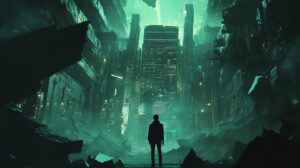
Luke continued. “The political incentive is simple: more surveillance capacity, more predictive control, more efficient coercion. The financial incentive is simple: reduce labor costs, increase efficiency, and concentrate profits. If companies can automate the middle class, they will. If they can reduce costs by making everyone replaceable, they will.”
Graham’s chest tightened. He didn’t disagree, he hated the gravity in the way Luke said it.
Luke’s voice lowered. “And then there’s war. Or if you don’t like that word, fine, conflict. Security. Competition. Whatever label makes it easier to swallow. But the logic is the same: AI makes the machinery of conflict faster, cheaper, more scalable. It makes propaganda more tailored, targeting more precise and the distance between decision and consequence more obscure.”
A chill ran through Graham’s body, recognition of the possibility he’d been avoiding.
Luke’s eyes stayed steady. “So yeah. Dystopia isn’t paranoia. It’s recognizing a pattern.”
They walked again, slower now.
Graham let the dystopian frame land fully, no quick rebuttal. He could feel its emotional core: not just fear, but grief and moral alarm. Luke wasn’t just being cynical; he was protecting something he loved from a future that tasted like cheap power.
But Graham also felt another truth, equally insistent.
He said, “And the utopian case?”
Luke’s mouth twitched. “You want me to argue for the other team now?”
“I want you to be honest,” Graham said, “admit people are seduced by it.”
Luke didn’t answer immediately. They passed a café with warm windows. Inside, two students leaned over a laptop, laughing. The youthful glow on their faces, it was seeing possibility.
Luke’s shoulders softened a fraction. “The utopian story,” Luke said, “is relief.”
“Yes,” Graham nodded.
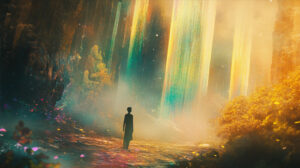 Luke continued, reluctantly generous. “It’s the fantasy of being freed from drudgery. From meaningless work. From endless administrative sludge. Breaking the bureaucratic chains! It’s the hope that we can stop wasting our human life on tasks that drain our souls.”
Graham felt his own heart respond to that. He knew the exhaustion in his friends, the way brilliant people were trapped in email overwhelm, schedule conflicts and survival economics.
Luke went on. “The dream, more time for creating art, for connection with friends, for feeding the ducks with our kids, for walks on the beach with the dog, for being alive. It’s accessibility too, tools that have been locked behind money and gatekeepers could suddenly be available to anyone with curiosity and creativity.”
He exhaled. “And that part… I get it.”
Graham looked at him. “Do you?”
Luke’s eyes flashed. “I’m not made of stone.”
Graham nodded, appreciative. He said softly, “You’re not wrong about the agendas, but neither is the longing.”
They walked in silence for a block, letting both truths exist.
Then Luke spoke again, and now his voice carried a different edge, something more vulnerable.
“But here’s the blind spot,” Luke said. “Utopia assumes the tool changes the system. It doesn’t, not by itself.”
Graham nodded. “And dystopia’s blind spot?”
Luke didn’t like this part. “It can turn into paralysis.”
“Yes,” Graham said. “Or into a righteous anger, protesting as action, nothing really changes.”
Luke glanced at him, annoyed but listening.
 Graham continued. “Fear becomes the posture, critique becomes the home. You know the fairytale story of Chicken Little…”the sky is falling…the sky is falling”…eventually people stop listening! We get so good at seeing what’s wrong that we don’t try to build something new!”
Luke’s face tightened, because it was true.
They turned a corner and the wind hit harder. A banner slapped against a pole. Somewhere a siren rose and fell.
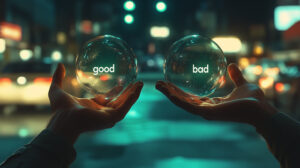
Graham said, “Here’s what I think is happening. We keep having the same argument, AI good, AI bad, and it goes nowhere because it’s the wrong conversation.”
Luke’s eyes narrowed. “Don’t.”
“Don’t what?”
“Don’t make this a TED talk,” Luke said, but his voice was tired, not hostile, he needed Graham to prove it in the body, not the mind.
Graham slowed. “Fine,” he said. “Let’s keep it human.”
He nodded toward the crowd, people laughing, arguing, shopping. “Look around, they don’t really want to see it. Why? The fear of becoming irrelevant. The fear of being ordinary. The fear that any one of them could be replaced by something ‘good enough’ and no one will care. Losing their identity!”
Luke’s jaw worked. “The world won’t care.”
Graham stopped again, turned fully toward Luke. “Is that your deepest fear?”
Luke didn’t answer, but his eyes betrayed him. Under the moral alarm was something more personal: grief for nuance, grief for taste, grief for a culture that already struggles to discern depth from drama.
Luke finally said, quietly, “People don’t know what’s good. They’re trained, the whole mediascape rewards speed and stickiness. If you flood the zone with mediocrity and call it art, most people accept it. What happens to the slow work? Apprenticeship. Patience. Craft. Wisdom.”
He looked away, voice cracking. “What happens to us?”
Graham felt it, Luke’s fear wasn’t just self-protection. It was his love for the craft, love for the human capacity to be moved by something real, our ability to give birth to something that never existed before!
Graham nodded slowly. “Okay,” he said. “And here’s the other nuance that nobody is naming.”
Luke looked back.
Graham said, “The dopamine hit of creation.”
Luke’s face tightened. “Yeah.”
 Graham continued. “People will press a button, get the sensation of authorship, and confuse that with making. They’ll feel the rush without the vulnerability. Output without encounter, the illusion of becoming without the practice of discipline.”
Luke exhaled like Graham had finally touched the nerve.
They walked again, and now the conversation felt less like debate and more like a confession. They passed a storefront with a TV in the window showing an AI demo. The host laughed, delighted at the speed. The crowd watched like it was magic.
Luke muttered, “It’s slot a machine with aesthetics.”
Graham didn’t disagree, and refused to surrender the future to that critique. He stopped under a tree whose leaves were half gone, branches scratching the night sky.
“Luke,” he said, voice low, “I’m going to ask you something, and you’re going to hate it.”
Luke’s mouth twitched. “Go on.”
Graham said, “Forget whether AI is good or bad.”
Luke’s shoulders rose slightly, bracing.
Graham continued anyway. “What do we want to create?”
The question landed like a single voice, echoing in a momentary silence in a crowded room, all eyes turning towards the speaker! Luke’s first reaction was anger, not at the question, but at what Graham was demanding: Responsibility. Imagination. Agency.
“What kind of question is that?” Luke said, in a tone sharper than he intended.
“The only one that changes anything,” Graham said quietly. “Because arguing about the tool is irrelevant, it’s a mirror. It only reflects the values of the system using it.”
Luke stared at him. The wind moved through the branches overhead.
Graham added, softer, “And if the system is currently asking AI to serve domination and profit maximization, we’re allowed to say: no. We’re allowed to build a different system.”
Luke’s eyes narrowed. “You think we can out-build the incentives.”
“I think we have to try,” Graham said. “The alternative is surrendering authorship of the future to fear and power.”
Luke looked down at the sidewalk. His hands were curled into fists inside his coat pockets. When he spoke, his voice was quieter.
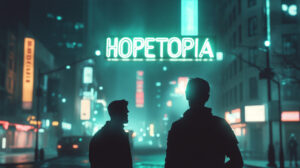 “Hopetopia,” he said, the word tasted strange.
Graham nodded. “Not naive optimism, not denial, hope with agency, imagination with moral clarity.”
Luke’s laugh was small, but not cruel. “You really believe that.”
“I believe it’s possible,” Graham said. “A practice, refusing to collapse into fatalism. A refusal to be seduced by hype, the third way.”
They stood there for a moment, letting the third way take shape between them, not an answer, but a posture.
Luke finally spoke, and his voice carried a new kind of honesty.
“I don’t want to become a gatekeeper,” he said. “I don’t want to be the guy protecting the old world because I’m scared.”
Graham nodded, “we don’t want a world where ‘good enough’ becomes the norm.”
“Exactly,” Luke said. “I want people to learn how to see. I want art that people feel. I want depth.”
Graham’s voice softened. “Then that’s what we build.”
Luke looked at him, wary. “How?”
Graham didn’t give a speech, he offered an image.
“Imagine,” he said, “AI used not to flood the market with noise, but to reduce the stupid friction that drains artists. Imagine it as an assistant that frees time for the part that can’t be automated: taste, judgment, lived experience, moral imagination.”
Luke’s eyes narrowed. “And who owns it?”
“That’s the question,” Graham said. “Who builds it, for what purpose, under what values.”
Luke’s shoulders dropped slightly, his body recognizing the conversation was finally moving forward.
Graham continued, “Hopetopia means we stop treating AI as our destiny. We leverage it, we fight for governance, for values, for the culture it’s embedded in.”
Luke stared at the billboard glow reflecting off a puddle. “That sounds… political.”
Graham chose his words carefully, keeping it human and universal. “It’s civic,” he said. “it’s about power and purpose, where the tools serve life over extraction.”
Luke didn’t argue. They started walking back toward the theater. The wind eased. The streetlights felt less harsh. As they walked, Luke’s face shifted, still wary, still alert, but less clenched.
“I hate that your question makes me feel hopeful,” he admitted.
Graham smiled faintly. “Good, that means you’re still alive.”
Luke shook his head, but there was a softness in it. “I’m not giving up my fear,” he said.
“Don’t,” Graham replied. “Fear is data. Just don’t let it be the only data.”
Luke nodded slowly. They passed a restaurant, looking in the front window, the staff stacking chairs, sweeping floors, resetting the room for tomorrow’s guests. Luke watched them for a moment, ordinary work, invisible, necessary. Then he said, almost to himself, “If AI is going to accelerate anything, it’s going to accelerate who we need to become.”
Graham nodded. “Exactly.”
Luke looked at him. “So Hopetopia is… choosing what we become.”
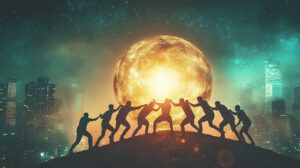 Graham’s eyes held steady. “Choosing what we build. Choosing what we reward. Choosing what we refuse.”
Luke gave a long exhale. He wasn’t converted. He wasn’t suddenly optimistic. But something had shifted: the conversation was no longer a fight over the tool. It was a design question about the world. And that, more than any headline,felt like the honest first step.
Not “Is AI good or bad?”
But “What do we want to create?”