Listening to Hear
Our current financial system is a machine where the gatekeepers are those who have accumulated the wealth that keeps the machine running and the machine is failing! There is a different option if we're listening.

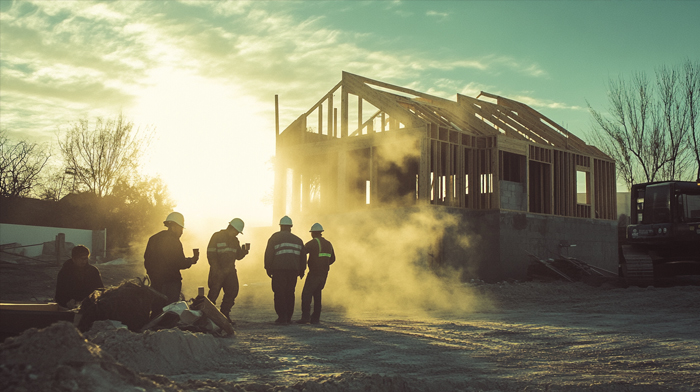
Gus and his crew arrived at the job site at about the same time the sun rose on their day. It was a crisp morning, and they could see their breath. They always started off with a team meeting, sipping on steaming coffee while everyone shared what they were working on for the day, any issues they found or any support they needed. The crew felt like a family.
Today, however, Miguel was running late. It didn’t happen often, just enough to be annoying, like a sink where the faucet drips if you don’t turn the valve off tightly. Gus didn’t want to tighten up on Miguel, he was a new part of the crew and a great worker. Gus had been a contractor for a long time, he knew the value of a good worker, so rather than getting angry, he got curious.
 Miguel arrived about 10 minutes after the meeting was supposed to start, rushing in, slightly out of breath, and extremely apologetic. As the meeting broke up, Gus asked Miguel to hang back for a minute. Miguel’s body tensed, waiting for the rebuke he expected. Gus started the conversation with a simple question, “Is everything okay?”
Surprised, Miguel’s body relaxed, and with genuine sincerity, he said, “Sorry I was late, it’s the traffic.”
Gus paused, not to create tension or evoke shame, to let his answer come from curiosity. “Maybe next time you can text me so we’re not standing around guessing.”
Miguel sighed with relief and then said the real thing, “Yes, thank you, it’s hard when I live a two-hour drive away. Most days it’s not a problem, and today there was an accident.”
Gus gave Miguel a friendly pat on the shoulder and said, “You’re an important part of the crew, and we support each other. Go ahead and get to work.”
It was in that interaction that Gus became aware of the deeper issue. He’d been building or remodeling houses in Oakmont for more decades than he cared to remember. He recalled the days when he knew where all the crew lived and, on occasion, would swing by to pick someone up because their car was in the shop.
Gus lived alone; he’d raised a family and a few years earlier had lost his wife. Work and his crew were his new family. He sat alone that night at the dinner table, reflecting on what had changed in Oakmont…as he was about to take the next bite, the answer came. It had happened right in front of him without him even knowing it. The homes he built or remodeled were not affordable to the people who were building them!






















The weight of that realization left a bitter taste in his mouth. He took a sip of his beer, hoping to wash the bitterness away. As he finished the meal and washed the dishes, an idea began to form in Gus’s head. What if he did something about it? Out loud, he said, “What if we built something that his family, Miguel, could afford to live in?”
The next day, same crisp air, same steaming coffee, Miguel in the circle because there wasn’t an accident that day. They did their normal check-ins, and at the end Gus did something the crew didn’t expect…looking directly at Miguel, he said, ”I have an idea to build housing here in Oakmont that guys like us could afford. What do you think?”
For a moment, there was a stunned silence…and then they all spoke at once…”Great idea!” “When do we start?” “Count me in,” and then the question nobody wants to hear, “How will we pay for it?”
Gus smiled, “Great question. You guys get to work and let me figure that out.” As he walked away, Miguel gave Gus a quick smile, “Thank you.”
 That night, Gus ate fast, his mind was churning with ideas and questions. He knew figuring out what it would cost was the place to start. It was something he did before every project. This was no different, maybe just a bigger scale. He worked at his desk into the wee hours of the night. Sketching up a site plan, designing floor plans that were simple, inexpensive, not cheap, utilitarian.
Over the next few weeks, he flushed out the details, land, zoning, drawings, materials, and labor costs. It was simple, 6 units, one studio, 3 one-bedroom, and 2 two-bedroom units. And the centerpiece, a central green space with gardens and a common building, laundry, common room, work space, and a guest room. This was the future of what community living could look like. He put together a package where he’d dotted all the I’s and crossed all the T’s.
Excited about the next step, he made an appointment at Oakmont First to discuss financing the project. He wore his cleanest work shirt and had a thick folder with the drawings and numbers. The bank lobby smelled of polished marble and some unnamed air freshener. Looking around, he saw the teller booths behind glass partitions, a huge stainless steel vault door, and a sitting area that looked nice and had never been used. There were even a few fake potted plants to give the illusion of life. To him, it felt sterile. He walked over to the single desk, and when the woman looked up from her screen, she said, “May I help you?”
“Yes,” he replied, “my name is Gus, and I have an appointment with Mr Roberts.”
She gazed back at her screen and said, “Yes, I’ll let Mr Roberts know you’re here,” and returned to whatever she was doing on her screen.
Gus stood there awkwardly for the few minutes it took for Mr Roberts to come from some office in the back. When the door opened, out emerged a young man, as polished as the floor of the bank, a crisp suit and tie, walking assuredly towards Gus. He reached out to shake Gus’s hand with a formal “pleased to meet you…let’s go back to my office” as he handed Gus a shiny embossed business card – Mr Roberts/Loan Officer.
As they walked through a sterile maze of corridors to his office, he asked if Gus was thirsty, you know, the kind of superficial conversation that sounds like comfort while in reality it’s just filling space. Gus politely declined. Mr Roberts sat behind an ornate wooden desk, 2 computer monitors, a keyboard, a stapler, pen holder, a formal name plate with his name and title, and for some unknown reason, an old fashioned hand crank adding machine!
 “Let’s see what you’ve got Gus.” he said with a formality that communicated he was the one in charge. The message, my decision is a No, and you have to convince me to become a Yes. Gus handed him the folder. He flipped through Gus’s drawings and spreadsheets, nodding here, grunting there, his eyes seeing the numbers, his mind missing the point. Finally, he spoke, “Interesting,” he said in a tone where he’s already decided what “interesting” means.
Gus leaned forward. “It’s needed,” he said. “Working guys can’t live here anymore. This keeps labor local. It keeps our town intact.” He nodded politely like Gus had just shared a personal hobby.
He then proceeded to tell Gus what wasn’t in his folders: Credit scores. Collateral. Return on investment. Market comps. A projected appreciation curve. A plan to “de-risk.” Gus tried to answer every question. He had numbers. He had history. He had twenty years of projects completed on time. But the banker’s eyes kept drifting to the same invisible equation: profit first, risk avoidance, the safety of lending to those already having capital.
“Affordable units,” Mr Roberts finally said, “tend to under-perform.”
Gus blinked. “Under-perform what? Market expectations,” he said, as if the market were some deity whose mood had to be served. Gus felt the anger rise. He was trying to fulfill a community need, sending up an SOS and was being met by the “Same Old Shit.” He said “So because it’s affordable, it’s not worth doing.”
Mr Roberts smiled; small, apologetic, institutional. “I’m saying it’s difficult to justify under our lending criteria.”
Gus stared at him. Lending criteria. Like a checklist was more real than a worker driving two hours to frame houses he couldn’t afford to live near. Mr Roberts slid a stack of paperwork toward Gus, like he was handing him a verdict. “If you can increase projected returns,” he said, “or secure a co-signer with stronger collateral, we can revisit.”
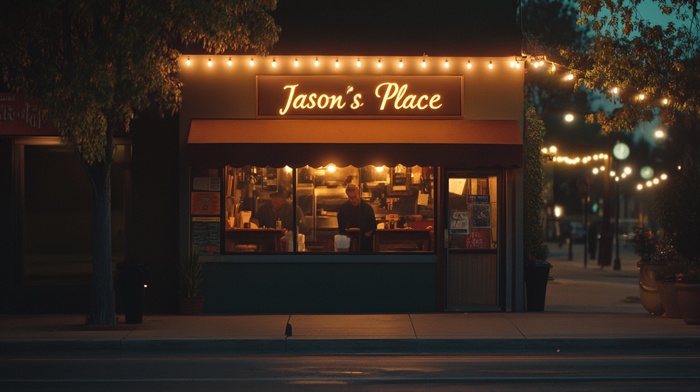
Gus looked down at the forms and felt the old world’s power settle on his shoulders like a 50-pound bag of cement. He walked out carrying paperwork he already knew would lead nowhere. The wind outside the bank was sharp. Gus stood for a moment on the sidewalk and watched cars pass, people going about their day, a town humming along, all the time quietly losing the workers who kept it alive. He didn’t go home. He had a pit in his stomach and finally realized he hadn’t eaten in 4 hours. He walked over to Jason’s diner.
 Jason’s place was the kind of place that remembered people. The bell above the door chimed, announcing their entry. The air smelled like coffee and onions on the flat-top. A couple of older guys in a booth argued vigorously about baseball and then broke out into laughter. Jason looked up from behind the counter, and his face warmed instantly.
“Gus,” he said, because the name meant something. “You look like you got into a fight with a spreadsheet.”
Gus slid onto a stool and exhaled through his nose. “Bank,” he said. “Same Old Shit.”
Jason nodded, already understanding. “Oakmont First?”
Gus made a sound, one filled with derision. “You know it.”
Jason poured him coffee without asking. That was what Jason did. He met people where they were, fed them and offered a sympathetic ear.
Gus stared at the steam rising from the cup. “I tried to finance a small housing build,” he said. “One that workers can afford. For people who actually keep this town alive.”
Jason leaned on the counter. “My waitress, Nancy, was just saying how hard it is to work and live in Oakmont. Let me guess, they said the numbers didn’t add up.”
Gus looked up. “Exactly.”
 Jason went quiet for a second, reflecting on the time, several months earlier, when he was struggling with his business. Jason had visited Ridgetown, trying to clear his head. Walking through the town square, it felt different. He’d noticed a bank that didn’t feel like a fortress, more like a public place. He walked in and immediately noticed the difference. It didn’t feel like a bank, open windows, real people, a bulletin board with photos of funded projects, and it even had a coffee bar with a person behind it. He walked up to the young woman at a desk and said “This place feels different. What is it?” With a wry smile, she said, “We’re the local public bank. We serve the public over investors.”
Gus coughed, bringing Jason’s attention back to the here and now, “You know, Gus, there’s a new public bank in town. They don’t work the way other banks do. The branch manager Sally, came in for dinner last week. She told me they’re looking for innovative local projects to get off the ground.
Gus stared at Jason, and in that contact, Jason could see a spark of hope. But just as fast, his skepticism leapt to the front, it sounded too good to be true. Jason reached under the counter and said, “Here, she left me her card.” Gus took the card, simple, on recycled/compostable paper – Sally Wainright/Community Development Enthusiast.
Jason continued anyway. “They still do numbers,” he said. “They’re not careless. But the question isn’t just ‘What’s the return?’ It’s ‘What does this do for this place?’”
Gus’s chest tightened. He didn’t want to feel hope because losing it was expensive. “Go talk to them,” Jason said. “Just… go.” Gus stared at the card like it might be a prank, a bucket of cold water about to drop. Then he tucked it into his wallet.
“Fine,” he said. “I’ll go.”
*A week later, Jason had an appointment and walked into Oakmont Community Bank. It looked like a civic building, but inside it was different. Warm wood. Local art on the walls. Live plants. A children’s corner with a small table and crayons. A bulletin board with community notices: tool library hours, garden harvest days, apprenticeship sign-ups. And yes, it even had a coffee bar staffed with a real person. He hated to admit it, his first thought…“Same Old Shit with a slicker facade.”.
The woman at the front desk flashed him a welcoming smile, like he belonged.
“Can I help you?” she asked.
“I have an appointment with Sally,” Gus said. The receptionist said, “I’ll let her know you’re here. Why don’t you run over and grab a cup of coffee.”
A few moments later, a woman in her forties came out to meet him, no suit, a simple, colorful dress, and a warm smile. “Gus,” Sally said. “Thanks for coming.”
 Sally’s office wasn’t ornate wood and meticulously organized. It had a window. Living plants. A table, big enough for papers, elbows, and honest conversation. They sat down together at the table, and Gus opened his folder. Plans. Budgets. Numbers. Sally went through it carefully, asking serious questions. The ones Gus knew were important. She didn’t skip feasibility or ignore costs. She did the part Gus expected. Then Sally asked something Gus didn’t expect. “Can you show me your work?”
Gus blinked. “My… work?” reminded him of the time in high school math class where the problem was so easy and the teacher knocked off a point because he didn’t show his work!
“A portfolio,” Sally said. “Projects you’ve built, remodels. References, people you’ve worked with.”
Gus stared. “You want to see… whether I’m good at what I do.”
Sally nodded. “We want to understand how you show up in the world. You’re asking the community to trust you with capital. We want to know how you’ve carried trust before.”
Gus felt something in his chest loosen. He almost laughed.
“I have that,” he said. “I have two decades of it.”
Sally smiled. “Good,” then added, “We also want to understand the need. Not just your need, Oakmont’s need.”
Gus frowned. “The need is obvious.”
Sally nodded. “To you. And to your crew. But we build the loan inside a network. We verify what’s real.” She flipped through her Rolodex and made a call. “Alicia?” Sally said into the phone. “It’s Sally. I’ve got a contractor here, Gus. He’s proposing six affordable units in Oakmont, close to job corridors. Can you join us for twenty minutes?”
Gus was stunned. Within a few minutes, Alicia arrived. She wasn’t a banker. She didn’t carry herself like someone who’d learned to hide behind bureaucracy. She carried a notebook and had the energy of doing fieldwork, someone who actually knew the town.
As Alicia sat down, Sally introduced her. Alicia works for a Community Wneeds Association. They work with the community to assess the broader needs…it goes beyond the individual to support the community, in Wneeds, the W is silent, and their work is to give it a voice.
Gus shook her hand, and she asked him about Miguel.
“How far does he commute?” she asked.
“Two hours,” Gus replied.
Alicia didn’t look surprised. “We have dozens of Miguels,” she said simply. “Workers. Caregivers. Servers. Teachers. People who are holding this town together from the outside because they can’t afford to be inside.”
She opened her notebook and shared local housing data, not abstract market charts, but lived realities: what rents were doing, how many workers had moved out, the pressure on families, the way commuting time was eating people’s lives.
“This isn’t just housing,” Alicia said quietly. “It’s stability. It’s time. It’s community continuity.” Gus felt the truth of that. Time was the hidden currency everyone was bleeding.
Sally listened, then he turned back to Gus. “Your plan is strong,” Sally said. “Your numbers are serious. Your budget is realistic. Your work history is solid.”
Gus held his breath. Sally continued, “Now we build the financing so it serves the need. Not to maximize profit, not to protect the bank, not to extract, to serve our community.”
Gus felt something like hope in his heart. He took a deep breath. Was this really happening?
Over the next few weeks, the real work happened. Laying out the terms like they were describing a bridge: still engineering, still math, but built for people to cross. There were safeguards. Milestones. Accountability. Stewardship in place of punishment. And there was something else, something Gus had never experienced in a bank.
Respect.
The months that followed weren’t magical. Permits still took time. Materials still fluctuated. Construction still demanded sweat, patience, and unexpected problem-solving. But the difference was the underlying system. Gus wasn’t fighting for permission inside a system designed to say no. He was working within a system designed to meet a need responsibly.
The public bank didn’t vanish after signing. They stayed involved. Not as controllers, but as partners in stewardship, checking in, helping solve bottlenecks, linking Gus with local suppliers, connecting the project to other community efforts so the benefits multiplied.
Alicia brought in the Community Wneeds Association, people who knew where the pressure points were, who could help prioritize applicants, who could ensure the housing actually served the workers it was meant for.
 Miguel stayed on the crew. Still occasionally late, but now texting. Still driving too far, but now with a different light in his eyes. One afternoon, Gus and Miguel stood on the parcel of land where the units would go. Survey stakes marked the corners. The ground was cold and firm.
Miguel looked around like he was trying not to believe. “This is… real?” he asked.
Gus nodded. “Real.”
Miguel’s voice broke slightly. “I could live here.”
Gus clapped him on the shoulder, not sentimental, just steady like family. “That’s the point.”
On that bright morning in early spring, they staged the photo. Not a glossy PR stunt, just a simple marker of a beginning. Something to go on the bulletin board at Oakmont Community Bank. Shovels. Hard hats. A small crowd. Someone’s kid running in circles, too excited to stand still.
Sally from the public bank stood beside Gus. Alicia was there too, holding her notebook like a quiet witness. Miguel stood off to the side with the crew, hands in his pockets, looking at the ground as if he might suddenly wake up from a dream.
Gus glanced toward the small knot of people with cameras, the local paper, and a couple of community folks, nothing flashy. Then he did something that changed Miguel’s posture instantly. Gus called out, “Miguel, come over here, get in the picture.”
Gus reached down, picked up one of the ceremonial shovels, and handed it to Miguel. He stared at it like it was heavier than it should be. “Me?” he asked.
Gus nodded. “Yeah. This started with you telling the truth. You don’t get pushed to the edge of the photo like you’re just labor. You’re part of the reason this exists.”
Miguel’s throat tightened with emotion. He looked at Gus. Gus met his eyes and nodded once, firm, grateful, unembarrassed. Miguel took the shovel. His shoulders squared. He stepped forward, into the line where Gus, Sally, and Alicia stood. Someone called, “Alright, here we go.”
Miguel lifted the shovel and pressed it into the soil. The dirt gave way with a satisfying crunch as an opening. Cameras clicked. Someone clapped. A child laughed. But the real thing being launched wasn’t just housing. It was a visible expression of a new system:
Gus had become part of a System Of Sharing built on a Network Of Trust.
Trust in a relationship, trust in visible contribution, trust as a community’s ability to recognize who is carrying the weight, and to route capital toward what keeps the community alive.
 And it starts like this…
A worker is late because he can’t afford to live nearby.
A boss who listens instead of scolds.
A diner owner whose intuition finally clicks into action.
A bank that treats capital as civic infrastructure.
A network that gathers, to build and share.
In parts of Oakmont, the old system still hummed, procedural, distant, convinced it was neutral while quietly choosing who belonged and who didn’t. Here, on this patch of earth, a different system was taking hold. The kind that doesn’t first ask, “What’s the return?” It asks, “What does the community need? And who has proven they can fulfill it?”