Listening to Hear
Our current financial system is a machine where the gatekeepers are those who have accumulated the wealth that keeps the machine running and the machine is failing! There is a different option if we're listening.


It was almost 11pm and Alicia’s mom realized she still hadn’t gotten her goodnight text. It was Alicia’s first year away at college and she promised to let her mom know she was okay. Almost as if the thought was a premonition, the phone rang.
“Hi mom…I’m okay…they finally let me make my phone call!”
Her mom was relieved…”What did you get arrested for this time?”
Alicia let out a short laugh, “We occupied the Provost’s office to protest tuition hikes and cuts to financial aid!”
“Are you hurt? Are you alone? Do you need money?” her mom asked.
It wasn’t the handcuffs, the chanting, the photo someone took of her sitting cross-legged on a cold tile floor beside three other students, her hair messy, her cheeks flushed, her eyes full of purpose. It was that last question that jarred Alicia!
She knew the money was there, because her family supported her in doing what she had just done. She knew her father would come get her. There would be money if bail was needed. They had connections and could hire a good lawyer if things became serious. She knew her family would be there for her. Finally she said “I’ll be fine, they’re releasing us with a desk appearance ticket.” She exchanged “I love you’s” with her mother and hung up.
 At nineteen, Alicia understood it as family. In later years she would come to see it as a privilege. A cushion, an escape hatch, a way out of consequences that most people didn’t have. That night, she only felt proud. She was a freshman at Belvedere College and followed in the footsteps of her family, becoming an activist. She was against banks, against greed, against racism, against tuition hikes, against war, against however “the system” was oppressing ordinary people.
She was not wrong, that was the complicated part. Families were losing homes. Students were graduating into debt. Neighborhoods were being renamed, repriced, and shutting out the people who had once simply lived there.
Alicia felt outrage. Protesting gave the outrage somewhere to go. The meetings, arguments in dorm rooms, late nights, printing flyers, marches, people speaking in large words about power and injustice. Alicia loved the urgency, being useful to a crowd. She loved using her voice, one that others followed. She would never admit it, she liked being someone who was fighting against “the system.”.
She had met Sally Wainright in her freshman history class. To her surprise, they were in the same dorm. Very quickly they started sharing notes, having study sessions and more importantly, late night discussions on some historical events. Sally was impressed by Alicia’s commitment to social change. By sophomore year, they became roommates in the dorm, they were inseparable.





















 Alicia pulled Sally into her world: student meetings, parties, lectures, weekend plans made casually. In return, Sally brought Alicia into another world without even knowing it. When everyone was going out to eat, Sally would say “I can’t afford it.”
Alicia would say, “Just come, I’ll cover you.”
Sally’s response, “That’s nice, I can’t, that’s not how I was brought up”
In the summer between her junior and senior years, Sally stayed on campus. Alicia invited her to her family’s beach house. “It’s not fancy,” Alicia said.
“You have a beach house,” Sally said.
“It’s old.” responded Alicia.
With an awkward smile Sally said “Okay, it’ll be fun.” All the time wondering what Alicia meant by that last statement.
The house had gray shingles, blue shutters, old towels, and sand in the entryway even after being freshly swept! Alicia told Sally about summers spent there since childhood. To her, it was normal. To Sally, it was foreign. There was enough of everything. Enough rooms, food, and the flexibility where plans could change without anyone’s face tightening.
After dinner one night where Alicia’s father had talked to the girls about their plans for their senior year and after college. Alicia was planning to travel, Sally was going to start looking for a job.
 Later that night, as they sat around the fire on the beach Sally said “do you know how lucky you are Alicia?”
“What do you mean?” Alicia said.
Tentatively Sally said, “you know how much I respect your activism, but I sometimes wonder if you know how privileged you are to be able to do it. And I wonder how much of a difference it makes.”
Alicia stared into the fire, pausing before saying “I never thought of it that way, it was how I was raised.” Yet it planted a seed in Alicia’s mind.
After graduation, Sally went home to Oakmont and started her job search. Alicia started traveling. She sent Sally pictures; Europe: London, Paris, Rome; South America: Rio, Buenos Aires, a small village in Peru. To Sally it was an unimagined freedom, for Alicia it was natural, yet that fireside conversation with Sally was ever present, “you’re privileged.”
Alicia got to see the difference between the developed world and the developing world. In Europe the familiar activists, protesting. What surprised her, in South America it was different, organizing. It showed up in Peru, in a small mountain town where rain had taken out a small footbridge. Without it, children walked the long way to school. Elders were trapped, unable to reach town. Women carrying food had to climb the hill slowly and stop halfway.
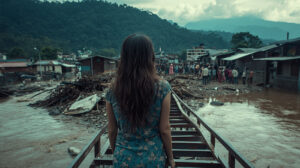 In Alicia’s world they might have protested to the government to do something. In their world, they organized and started rebuilding. When Alicia showed up she was ready to help, or maybe ready to be seen helping. She introduced herself to a woman named Milutza, explained that she had organized student actions in college, asked about schedules, materials, volunteers, and documentation.
Milutza listened. Then she handed Alicia a coil of rope. “Take this down,” pointing toward the river.
Alicia was surprised, it wasn’t what she expected, the rope was heavy. By evening, her hands hurt, her socks were damp. No one had asked what she believed. They only cared whether she did her part. For the next few days, Alicia carried rope, boards, water, stones, whatever was needed. Eventually she stopped trying to improve the work and started watching it.
She watched Milutza know who needed rest before they asked. She watched a man with bad knees teach a boy how to set a post. She watched a grandmother bring food and somehow settle three disagreements without seeming involved in any of them. Nothing looked like leadership as Alicia had experienced it. Yet it worked.
One evening, near the almost finished bridge, Alicia said, “I used to protest things like this.”
Milutza looked at the river. “Bridges?”
Alicia laughed a little. “No. Neglect. Poverty. A system that leaves people with problems they didn’t create.”
Milutza nodded.
 “I thought being against it meant I was helping” Alicia continued.
Milutza was quiet for a while before saying. “Sometimes it helps, makes people aware.” Then, after another pause: “But in the morning, there still isn’t a bridge.”
In that moment what Sally had said to her around the campfire landed with its full weight. For all her activism, nothing had changed!
The next day she sent a new set of pictures to Sally, showing people working on the bridge, sitting together, covered in mud, with smiles on their faces. Showing the progress of the bridge. A community coming together to solve a problem. It was incomplete, but there was progress.
Along with the pictures, a note “thank you Sally, you made me see the world from a different perspective. These people showed me I can do more than protest. I can be a part of doing something about it.”
A few weeks later Alica stopped in Oakmont to see her friend. Sally could see something was different about Alicia. As they walked around Oakmont, and saw how the city was suffering in “the system.” The outrage was still there, but it was being channeled in a new way. Alicia was saying “we have to do something about this.”
 As the days became weeks and the weeks became months, Alicia fell in love with Oakmont, the place, the people, the possibilities. One day, while Sally worked, Alicia walked through Oakmont and stumbled on the Community Wneeds Association. It wasn’t big, a small office, unpretentious: folding chairs, a noisy printer, a map taped to the wall, sticky notes on a whiteboard, organized under headings: housing, food, transportation, repairs, school lunches.
Alicia’s eyes had a distant look, thinking about her time with Milutza, the bridge, the rope, the mud. An older woman turned and looked at her. “Are you here to watch or help?” The force of the question brought Alicia back to the present moment. “I’m not sure yet,” Alicia said. “I’m trying to learn.”
The woman studied her, then pointed to a stack of papers. “Start there.” So Alicia started there. Not dramatically, not perfectly. She copied forms, made calls, took notes and brought coffee. She learned who trusted the association and who had good reasons not to. Learned how much work had been happening before she arrived, how they were building a different kind of bridge!
Privilege did not disappear because she noticed it. It remained in her education, her confidence, her family, her ability to survive uncertainty with more room than Sally had ever been given. She began to understand privilege less as a verdict and more as a debt. Not a debt to be performed in public. A debt to be paid in usefulness. In staying, in listening, in becoming dependable.
 Alicia decided to stay in Oakmont, close to her friend, but more importantly close to work that she knew made a difference. She changed her worldview from being against things to taking a stand for something new, different, better.
ANOTHER WORLD IS POSSIBLE.
She believed that, and knew that it was unfinished. Knowing, when the morning comes, someone has to build the bridge.