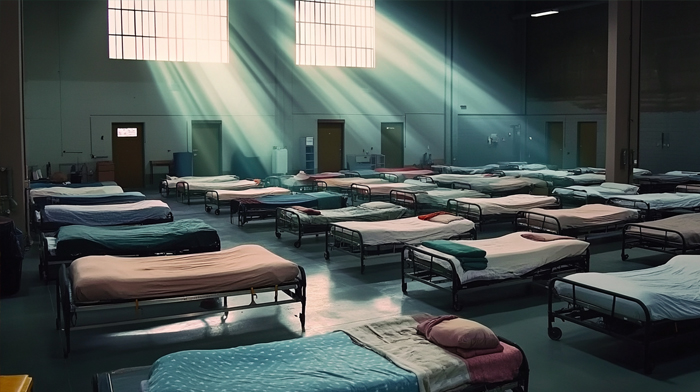
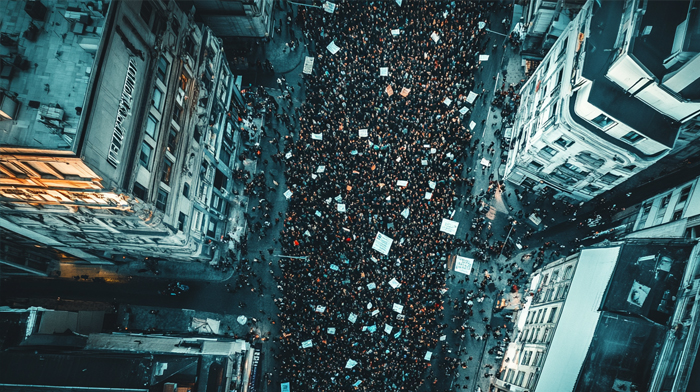
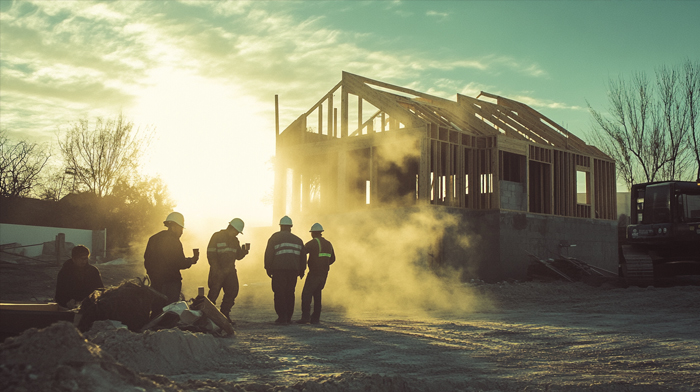
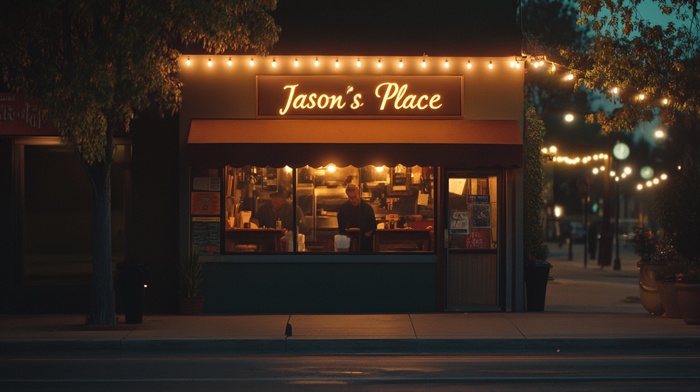
 Then just as fast, turning, the image shifted; the other side of the bridge, Ridgetown, appeared. Not as a fantasy city, not golden or perfect, but alive in a way Oakmont was not. He saw a small bank with people walking in without fear. A contractor unrolling plans at a table beside a woman with a notebook. A grocer signing papers with two employees and an older customer standing behind him. A local school kitchen receiving crates from nearby farms. A repair crew fixing a porch for an elder who kept trying to hand them lemonade. A young mother, using an app, not to prove she was poor enough for help, but to exchange hours she had contributed for food, childcare, a ride, and dignity. The images happened quickly, too specific to be hallucination and too impossible to be a memory.
Then Dylan saw the bridge itself, not as the monument he had funded, but as a transition. Capital was not supposed to be the goal; it was supposed to be a crossing. His knees went weak enough that he had to grip the rail.
The vision vanished. Oakmont returned; Ridgetown was Ridgetown again, dim and unfinished across the river. The water kept moving as if nothing had happened. But Dylan’s life had split, he crossed over the bridge!
 He did not tell anyone about the flash. Not yet; he didn’t have words. Men like Dylan were allowed breakdowns only if they could be converted into leadership narratives, and he knew enough by then to distrust his own instinct for narrative. So he did something smaller and stranger for him: he listened. At first, badly, but committed to the flash.
Alicia met him three weeks later in the basement of a church in Ridgetown, where the Community Wneeds Association was holding one of its early meetings. The fluorescent lights buzzed. The coffee was terrible. The folding chairs pinched at the back of Dylan’s legs. No one seemed particularly impressed that he was there, which he found both refreshing and irritating.
Alicia did not introduce him as a donor. She introduced him as “Dylan, who asked to sit in, to listen.” He sat in.
People talked about rent, food, transportation, the trade skills center that couldn’t get financing, the worker cooperative Oakmont First had classified as “nonstandard,” the affordable housing proposal rejected because the returns were too low. Dylan kept wanting to offer solutions; he knew the machine! He could feel the familiar reflex: pick a problem, fund it, announce progress, move the room toward gratitude. More than once, he started to open his mouth.
Alicia glanced at him each time. Not sharply, just enough that he stopped himself.
After the meeting, he found her stacking chairs. “I could fund the trade center,” he said.
“I’m sure you could.”
“And the cooperative.”
“Probably.”
“And housing.”
Alicia slid one chair against the wall. “For how long?”
He frowned. “What do you mean?”
 “I mean, do you want to keep selecting emergencies one at a time? Or do you want to understand why all the useful things are waiting outside the door for money?”
Her words landed like a brick dropped from the top floor of a building; Dylan did not answer.
She kept stacking chairs. “The people in that room don’t lack ideas. They don’t lack work ethic. They don’t lack need. They lack access to capital on terms that make sense for what they’re building.”
“That sounds like banking,” he said.
“It is banking,” Alicia said. “That’s the problem.”
A week later she introduced him to Nicole.
 They met in a plain office in Ridgetown, the kind of room Dylan would once have overlooked because nothing in it signaled power. No marble. No art selected by a consultant. Just a long table, a map of the region, and a whiteboard covered in notes that seemed both practical and alive.
Nicole had once worked at Oakmont First. Dylan knew that before he arrived, but it meant something different when she began speaking. She did not hate banks. That surprised him. She hated what banking had become when it forgot what it was for.
“Private banks are built to protect and grow private capital,” Nicole said. “That doesn’t make every banker bad. But it does shape the decisions. Money flows toward what can pay it back with the most gain and the least trouble. Public needs become secondary unless they can be converted into return.”
Dylan thought of the trade center. The cooperative. The housing. All useful. All difficult to finance.
“So what’s the alternative?” he asked, though part of him already knew.
“A public bank,” Nicole said.
She continued, “Not charity. Not reckless lending. A bank whose purpose is public benefit. It still evaluates numbers, feasibility, stewardship, repayment. But it asks different questions. Does this strengthen the community? Does it meet a real need? Does it keep value circulating locally? Does it build capacity instead of dependency?”
 Dylan’s jaw dropped; he looked at the map on the wall. Oakmont. Ridgetown. The river. The bridge. He suddenly saw an alternative to the machine! Back to the flash: money moving differently, not as a command and control, but as a current redirected through the places life was happening.
“My foundation can capitalize it,” he said.
Nicole’s eyes narrowed slightly. “Your foundation can help.” That last word landed for Dylan. Help, not own, not brand, not lead…Help.
Alicia, sitting beside him, smiled as if she had been waiting for Nicole to say exactly that.
The months after that were not cinematic. That was another lesson Dylan had to accept. There were meetings, charters, legal reviews, governance fights, public forums, arguments over accountability, fears about bureaucracy, fears about capture, fears about letting another powerful institution pretend to serve people while quietly serving itself. Dylan sometimes grew impatient, and still he continued to listen. He was used to speed, to decisions made in rooms where everyone understood that his time was valuable.
At one meeting, after a long debate about community oversight, he finally said, “We’re going to bury this thing in process before it ever opens.”
An older man from Ridgetown’s repair circle looked at him and said, “And if we don’t build the process right, people like you will find a way to own.”
The room went quiet. Dylan wanted to object. He didn’t; he knew how the machine operated!
He wrote that sentence down. It became a cornerstone of his education. Rules could become cages, but no structure at all meant power flowed back to the usual places. The answer was not bureaucracy. It was trust, memory, and wisdom. Open books. Rotating community seats. Lending circles connected to real need. Decisions made by the people impacted. Public reporting people could understand. Enough structure to protect the commons, not so much that the commons had to hire experts to speak for it.
 Dylan began to see that the public bank was not just a financial institution. It was a different story about trust. The old system trusted collateral, credit history, scale, and proximity to wealth. This new thing would still respect math, but it would also trust demonstrated contribution, local knowledge, relationships, and public usefulness.
It sounded almost naïve until he remembered how naïve the old system had been in the other direction. It had trusted profit as if profit were wisdom. It had trusted growth as if growth represented health. It had built a house of cards and called the height an achievement.
One evening, long after another meeting had ended, Dylan walked with Alicia toward the bridge. “You know what I keep thinking?” he said. “I spent years asking what causes to fund. Nobody taught me to ask what infrastructure would make the cause less necessary.”
Alicia looked across the river. “You couldn’t have heard it then.”
He smiled a little. “No. I probably would have put my name on it.”
“You still might want to.”
“I do,” he admitted.
She laughed, not unkindly. “Good. At least you know that now.”
That was Alicia’s gift. She did not flatter his transformation. She did not let him turn humility into another performance. She treated him like a man learning to hear, to become useful, which was far more demanding than being praised as generous.
The public bank opened without a gala. Dylan’s communications team hated it. There was no giant check, no donor wall, no dramatic film of his redemption. The sign simply went up on a restored municipal building near the bridge:
 RIDGEMONT PUBLIC BANK
Capital in Service of Community Needs
Nicole stood with the first lending circle. Alicia was talking with residents beside a map marked with housing pressure, food access, transportation gaps, and local enterprise needs. Gus had come in dusty from a job site to discuss a worker housing proposal. Daniel Reyes was there too, representing the grocery cooperative that had once been too “nonstandard” for Oakmont First. A trade instructor brought three apprentices who looked unsure whether they were allowed in a bank.
Dylan stood near the back. Someone asked if he wanted to say a few words. He shook his head. For once, silence did not feel like absence; he had learned how to listen.
A young woman from the contribution exchange walked past carrying a handwritten sign for the wall: What can you contribute this week? Beneath it were columns for care, repair, food, teaching, building, rides, bookkeeping, listening. Dylan watched people begin writing their names in small, uneven handwriting. He wrote his name under the listening column. Capital had helped open the door, but it was not the only currency entering the room.
Across the bridge, Oakmont still stood. The machine had not vanished. The towers still glowed. The bankers still funded where the numbers added up. The house of cards still looked, from certain angles, like a skyline.
But Dylan had seen beyond the veil once, and the vision had become work. Not his work alone. That mattered most. His money had become seed, not a throne. His access had become a tool, not an identity. His name had become less important than what could now move without him.
 Later, as the room filled and the first loan documents were laid on the table, Dylan stepped outside and walked back towards the bridge. The river was bright in the afternoon sun. This time, when he looked down, his reflection did not disappear.
It simply looked smaller. It felt right. The billionaire savior had not saved the world. He had finally stepped out of its way long enough to help build a bridge.


 Dylan leaned over the railing and saw his reflection broken by the current. For a moment, he recalled what the world had called him: philanthropist, visionary, billionaire, savior. A man who had given millions to housing programs while a riverbank community was pushed out of sight for a project bearing his name. A man who had funded food initiatives, clinics, scholarships, and environmental work, while somehow operating within the machine that kept producing the very wounds he was celebrated for treating.